
The complete guide
How to Choose a World Globe That Actually Gets Used
The problem with flat maps
Most of us learn the world from rectangles. A map on a classroom wall, a map in an atlas, a map on a phone. They are useful, but they all share one flaw. You cannot flatten a sphere onto paper without stretching something, and the stretching always lands in the same places. Greenland swells to look the size of a continent. Antarctica smears into an endless white strip across the bottom. Shipping routes that curve gracefully across the top of the planet appear on paper as weird detours.
A globe fixes that in one move. Shapes are right, distances are right, and the relationship between places stops being an abstraction. When someone asks why a flight from Sydney to London goes anywhere near the Middle East, you can answer it by turning a sphere rather than drawing a diagram. That is the real argument for keeping a physical globe around, even in a house full of screens.
Why size changes everything
Globe shopping tends to go wrong in one specific way. People buy small, because small looks tidy and costs less, and then the globe sits unused because nobody can read it.
The reason is simple arithmetic. The surface area of a sphere grows with the square of its size. A globe half the diameter has only a quarter of the printable surface, so the cartographer has to shrink the type or drop labels entirely. Small countries lose their names. Capitals vanish. You end up with a decorative object rather than a working reference.
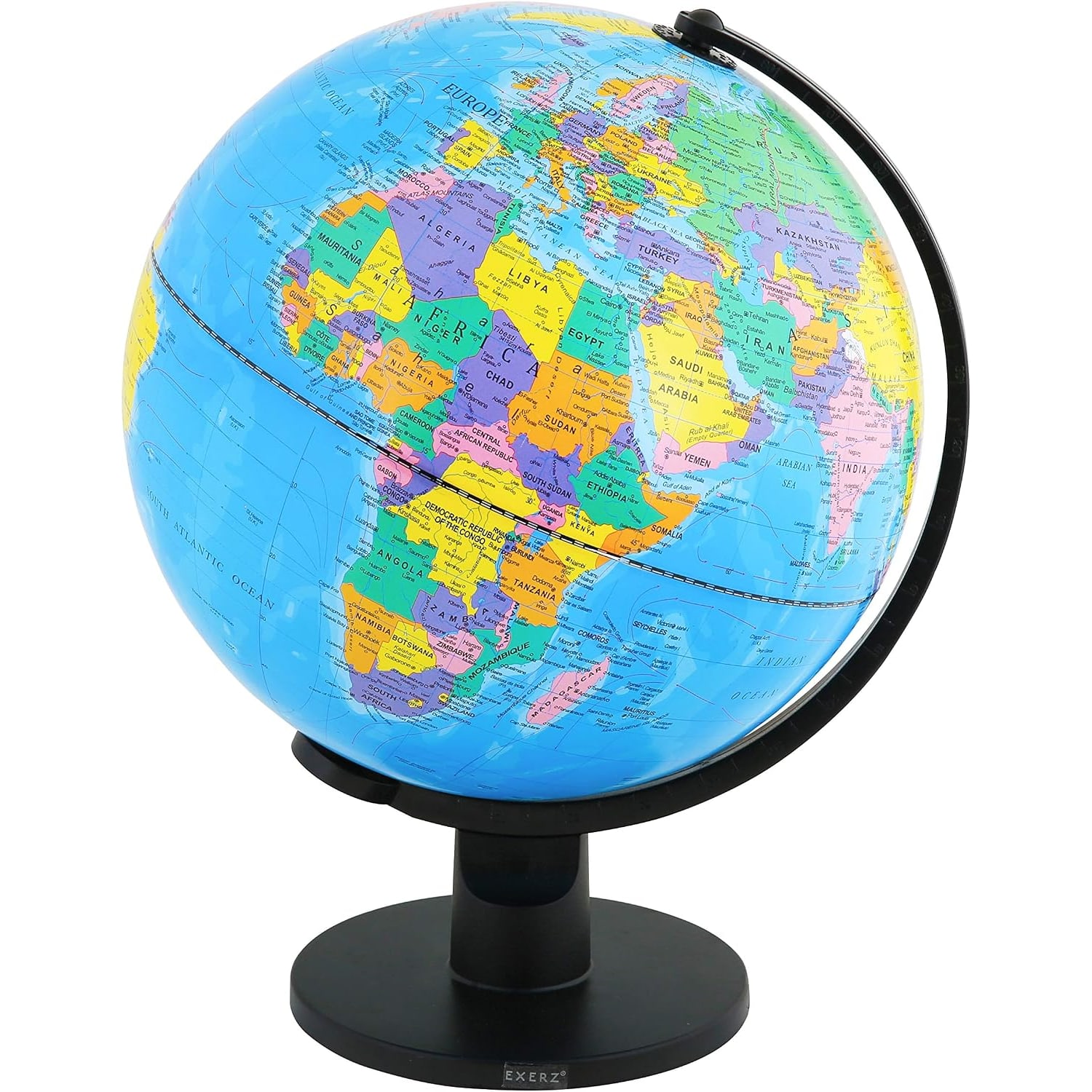
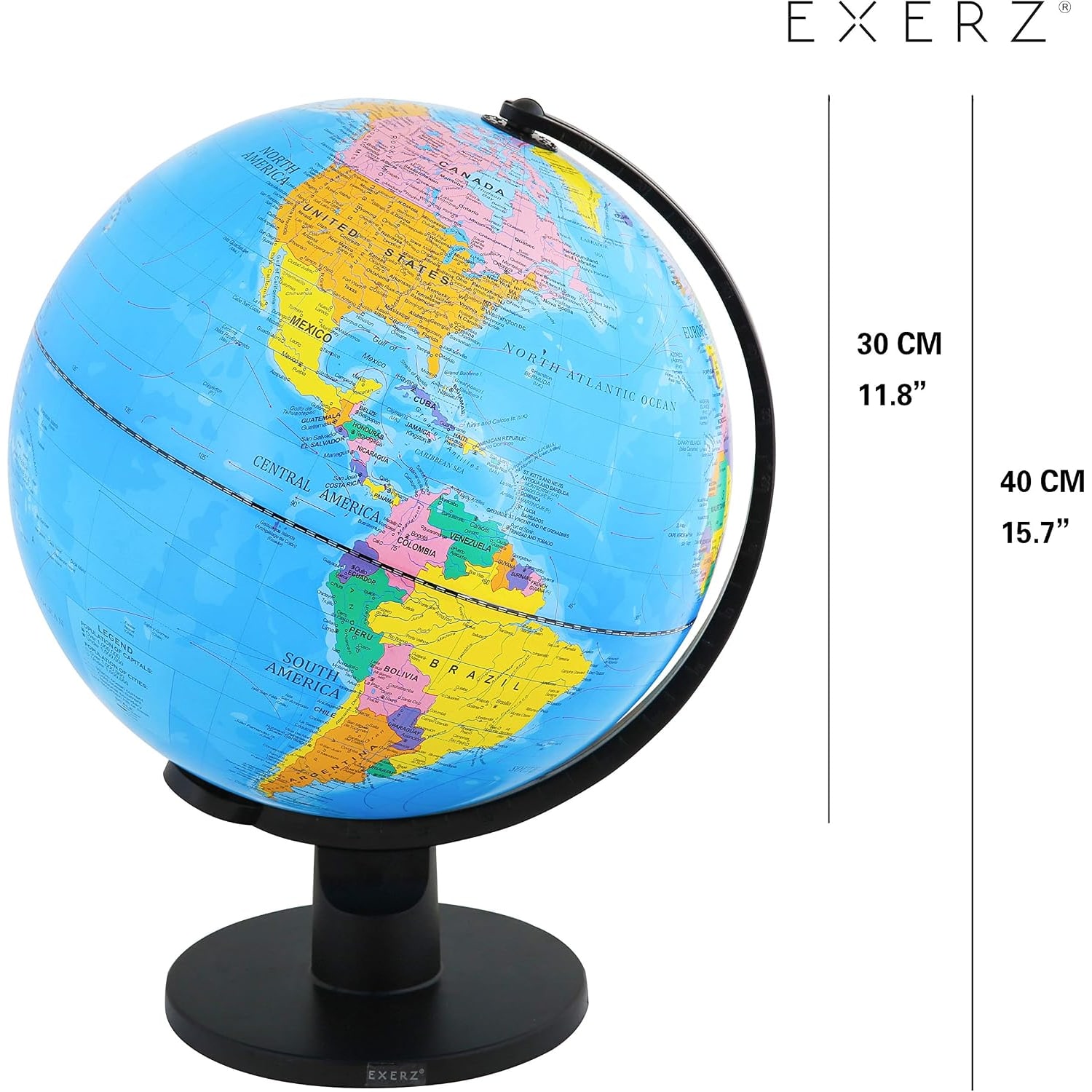
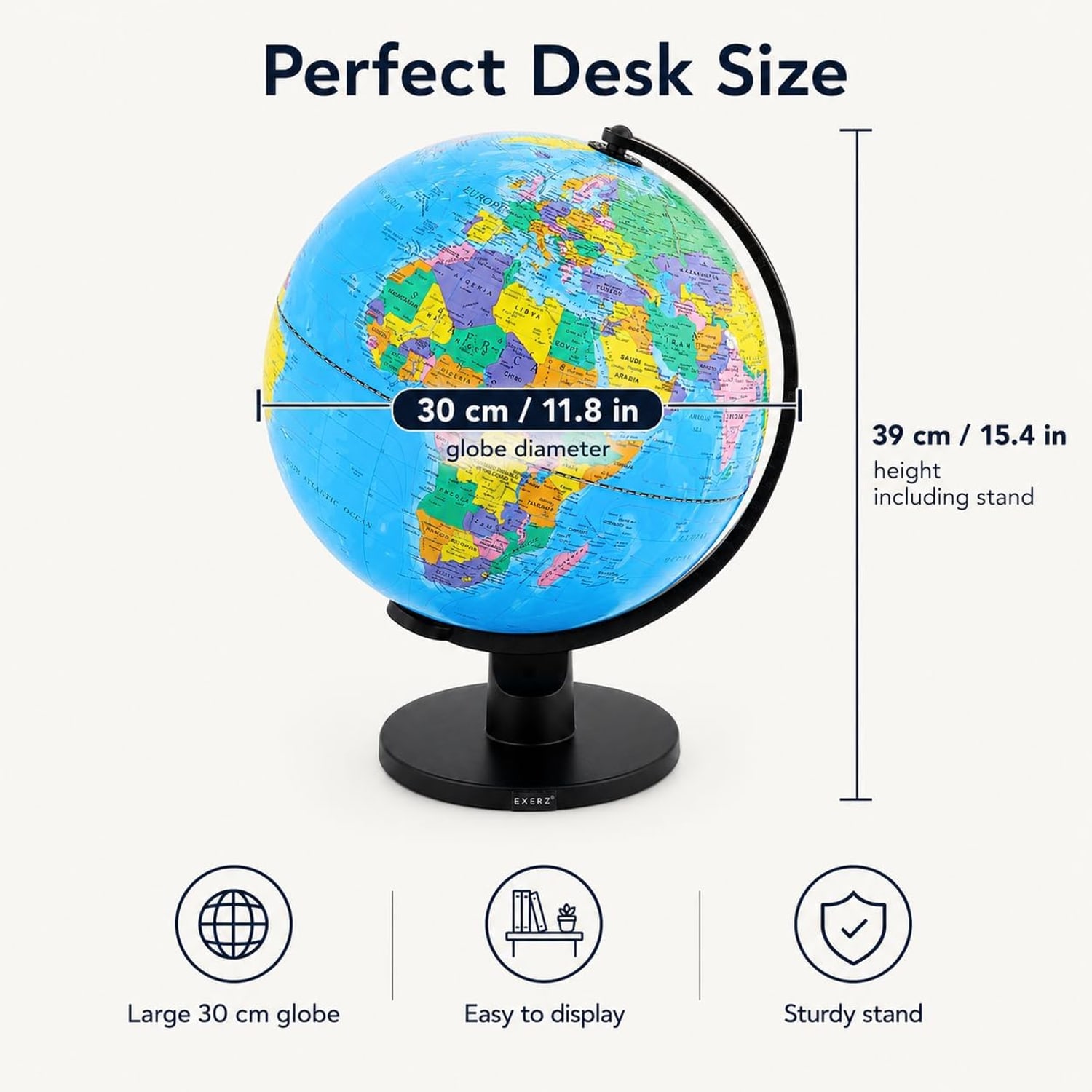
At 30 centimetres, there is enough surface for country names, capitals, major cities, ocean names and clean border lines. That is the practical threshold where a globe stops being an ornament and starts being something you actually consult. If you are after the best large globe for learning, diameter is the first number to check, well before you worry about finishes or colour schemes.
Political or physical
Globes generally come in two flavours. A physical map shows terrain, with greens for lowland, browns for mountains and blues shaded by ocean depth. A political map colours each country separately and focuses on borders, capitals and cities.
Both are useful, but they answer different questions. Physical maps are good for understanding why rivers run where they do, or why a mountain range sits between two cultures. Political maps answer the questions that actually come up day to day. Where is that country in the news. What is its capital. Who does it border. Which ocean is it on.
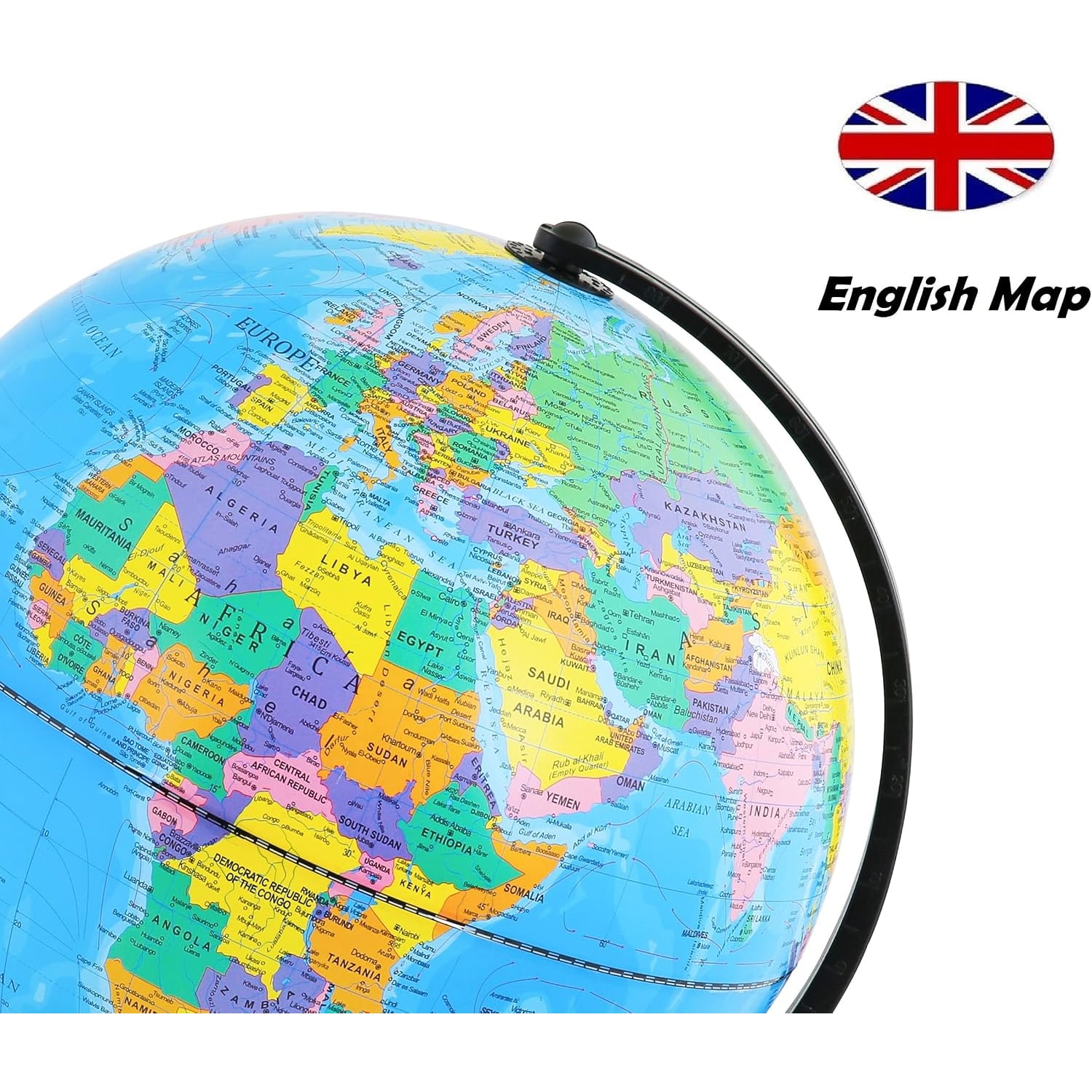
This globe uses an English political map, which lines up with the way school geography is taught and the way news stories are framed. If you were choosing the best political globe for general household use, that is the right call. Terrain is interesting, but most people reach for a globe because a place name came up and they want to put it somewhere.
The swivel matters more than you think
There is a small detail that decides whether a globe gets used or just dusted. How easily it turns.
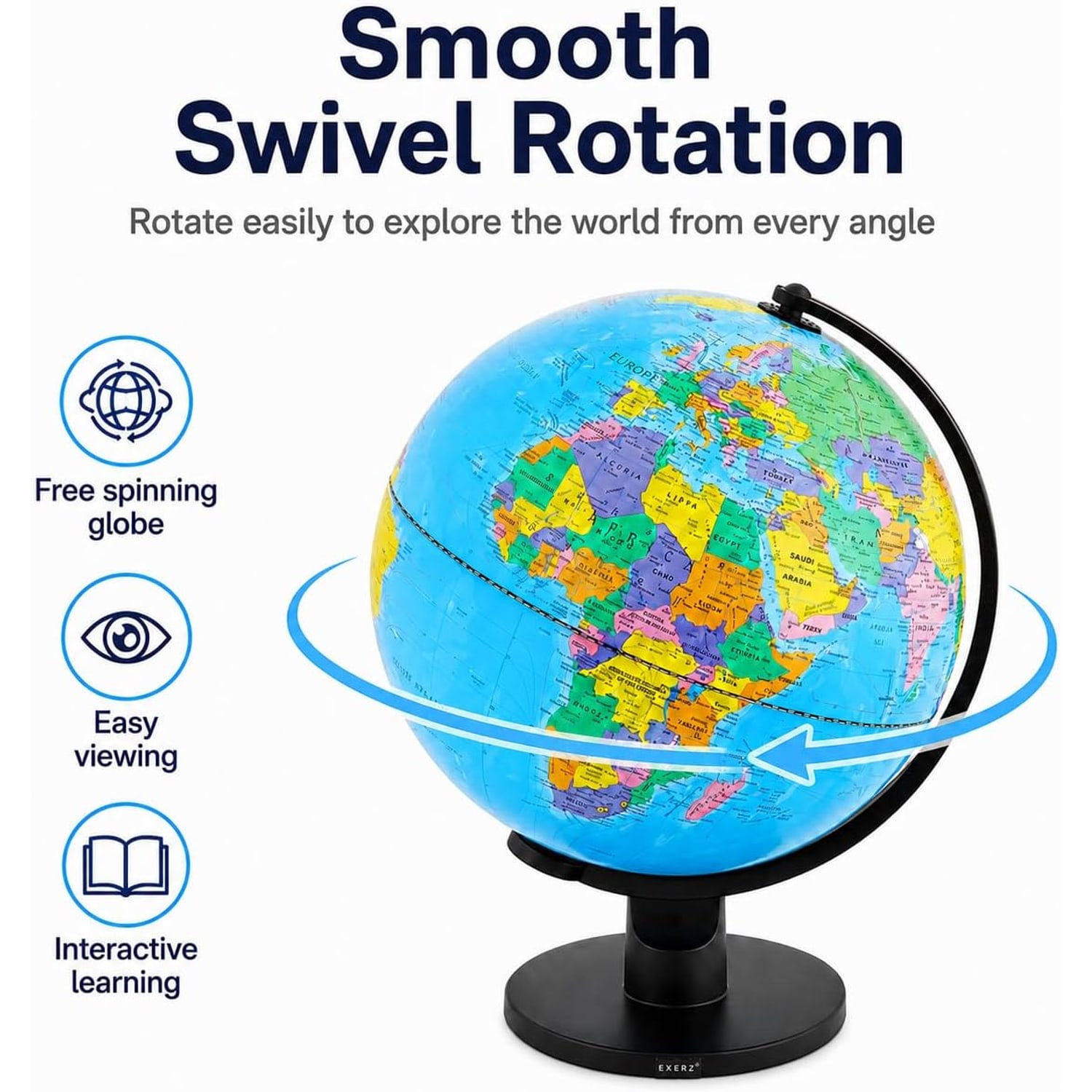
If the sphere binds, sticks or wobbles on its mount, people stop touching it. The whole interaction depends on being able to spin it quickly, catch it with a finger and land near the right continent. When that works, a globe becomes part of conversations. Someone mentions Chile, somebody else reaches over and spins it, and twenty seconds later three people are looking at South America.
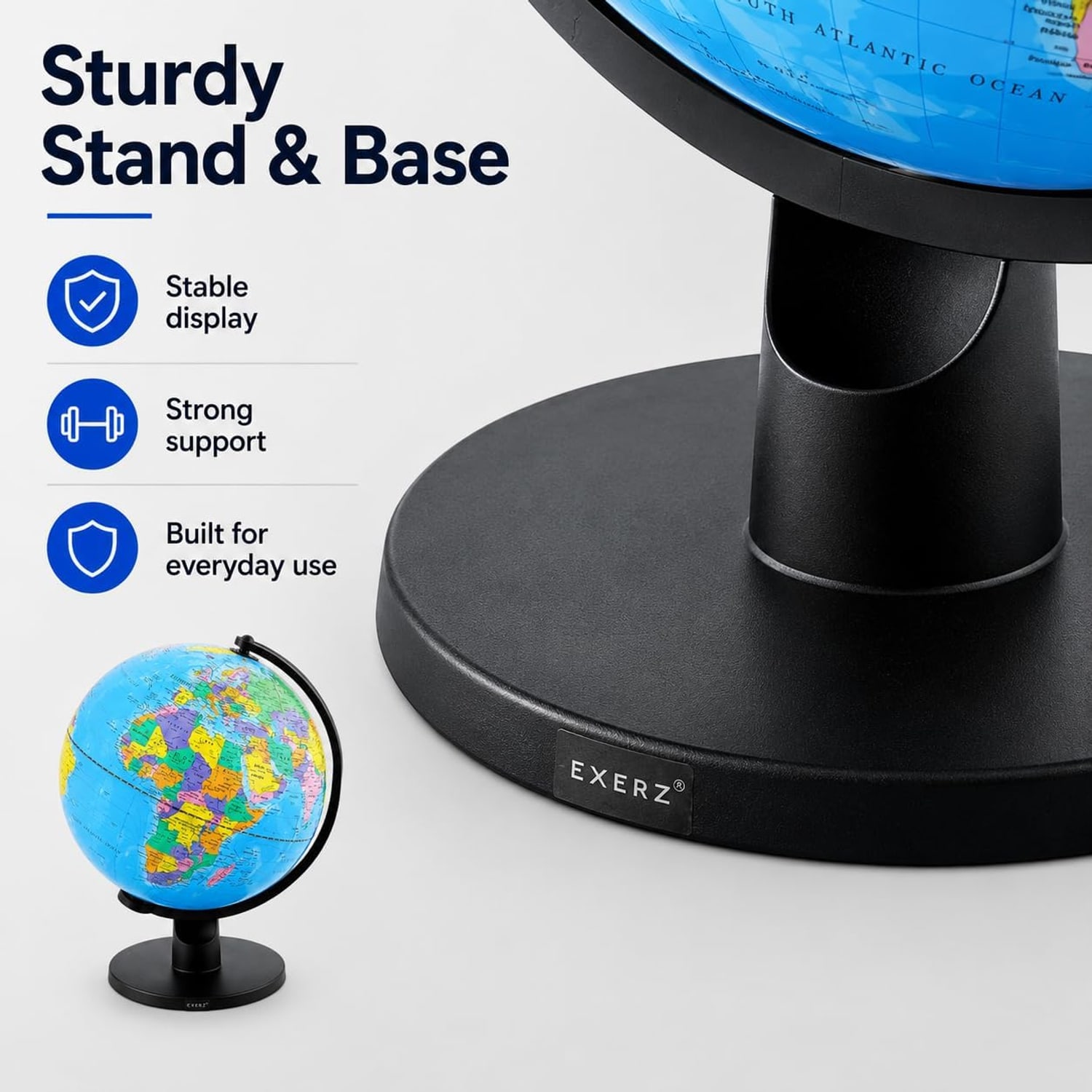
This one is built around a smooth swivel on a plastic and metal base with a polished finish. The base is what keeps the whole arrangement steady while the sphere moves. A good rotating world globe needs both halves of that equation, free movement up top and a planted foot underneath.
Weight and where it will live
The globe weighs 1.04 kg. That number tells you something about how it will behave in a room.
It is heavy enough to stay where you put it. A knocked elbow or a passing schoolbag will not send it rolling off a bench. At the same time, it is light enough that a child can carry it from a bedroom to the kitchen table without a problem, which matters if the globe is meant to be shared rather than parked in one spot.
For placement, allow a clear circle of around 35 centimetres. That covers the sphere plus the base and gives room to spin without knocking a coffee cup. Desks, bookshelves with generous height, classroom benches and sideboards all work. A crowded study desk with a monitor stand and a stack of folders probably does not.
Who it suits
The obvious audience is school age students, and for that it does the job well. A political globe sitting next to the homework pile means geography questions get answered rather than skipped. It is a sensible pick if you are hunting for the best world globe for kids who have reached the reading stage.
Teachers are the second group. A 30 centimetre sphere can be gathered around by a small group, which makes it practical as a classroom world globe for a reading corner or a project table. For a very large room you would want more than one, since the whole point is that everyone can read the labels.
Then there are adults. Plenty of people buy a globe for an office, a studio or a living room because it does two jobs at once. It is useful, and it looks like something. People who travel, follow international news or just like maps tend to find it earns its space. Choosing the best globe for geography study and choosing a good looking desk object often land on the same product.
Looking after it
Care is undemanding. Wipe the sphere with a soft dry cloth, or one that is only just damp if there are fingerprints. Printed map surfaces do not love household sprays, solvents or abrasive pads, so leave those out of it entirely. If you have used any moisture, dry it off straight away.
Sunlight is the other thing worth managing. Long hours of strong direct sun will eventually dull any printed colour, so a spot that gets bright indirect light is better than a sunny windowsill. When you move it, lift by the base rather than the sphere. That keeps the load off the swivel mount, which is the one moving part in the whole thing.
What is not stated
Worth being straight about this. Some details are not listed for this item, and we would rather leave them blank than invent them. The brand, the colour description, the assembled height including the base and the packaged dimensions are not specified. There is no stated warranty, no listed certification and no rating information.
What is confirmed is the 30 centimetre diameter, the plastic sphere with a polished finish, the plastic and metal base, the English political map covering countries, capitals, cities, oceans and borders and the 1.04 kg weight.
The short version
If you want a globe that gets picked up rather than ignored, buy one big enough to read. Thirty centimetres clears that bar. The political map answers the questions people actually ask, the swivel makes looking something up fast enough to be worth doing, and the weight keeps it planted on a desk without making it a chore to move.
It is a simple object that does one thing properly. The world, in the right shape, within reach.