
The complete guide
Choosing A Pretend Play Food Set That Actually Gets Played With
The toy pile problem
Most homes with young children end up with a shelf of toys that get used twice. It is rarely because the toy was bad. It is usually because the toy only did one thing, and once a child had seen it do that thing, the game was over.
Pretend food sits in a different category. It does not perform. It waits for the child to decide what it is. A wooden scoop can be ice cream in the morning, mashed potato at lunch, and some invented purple flavour by dinner. That open-endedness is why play food stays in rotation long after the noisy plastic things have gone quiet in a cupboard.
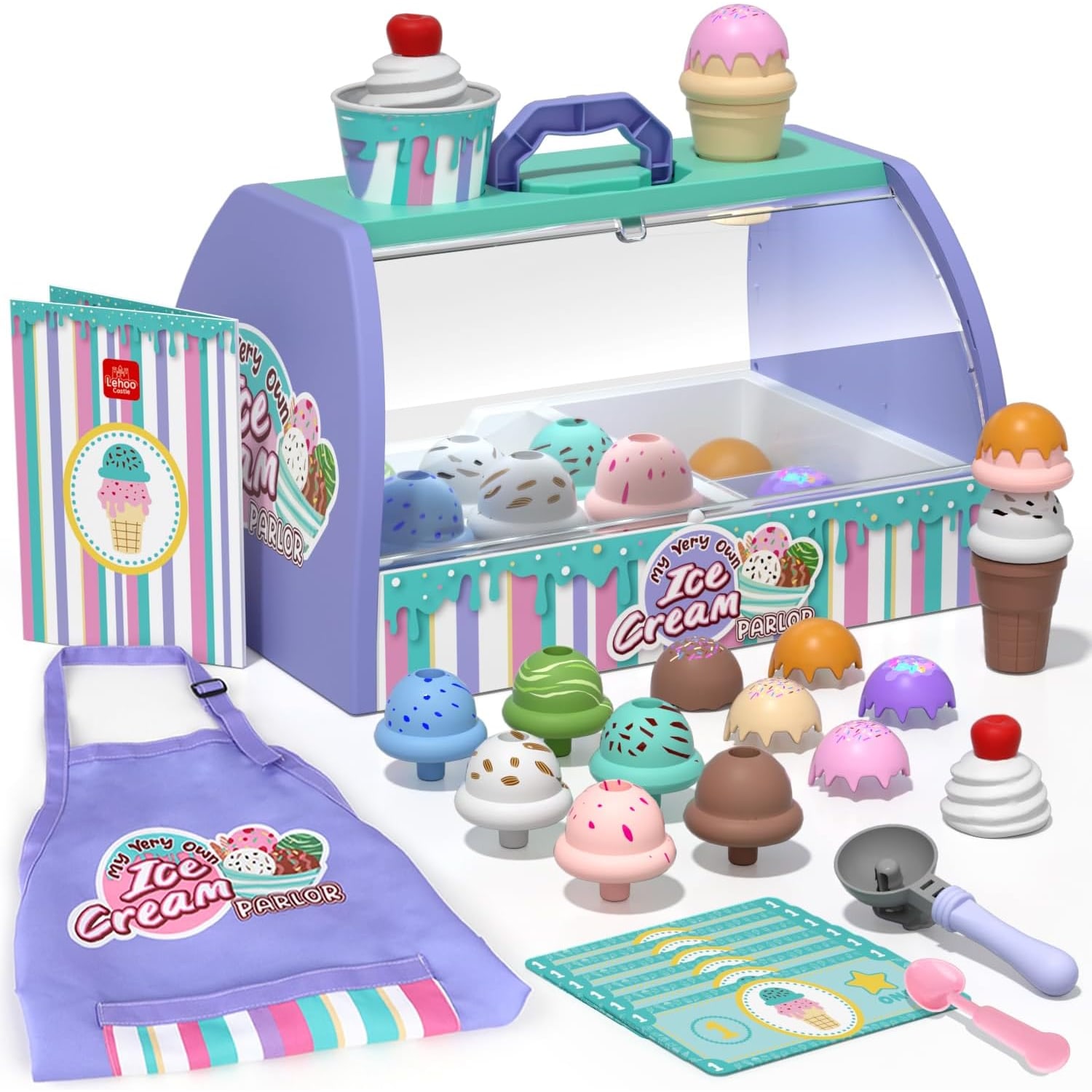
This wooden pretend play food set takes an ice cream shop as its starting point, which is an easy idea for a three year old to grab hold of. Everybody understands ordering an ice cream. From there the pieces do the rest.
How a mix-and-match food set works
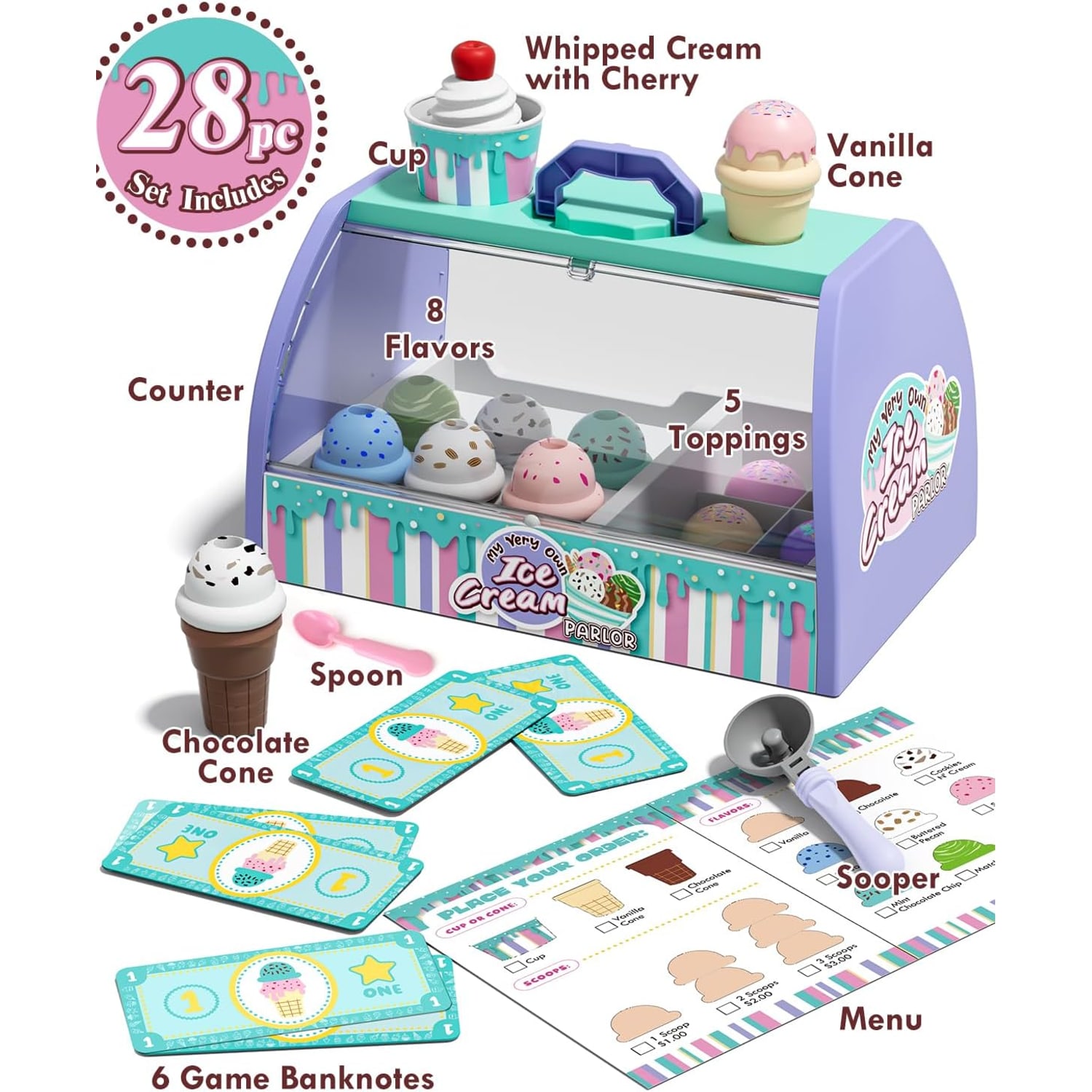
The core idea is simple. Instead of one fixed toy ice cream, you get separate parts for flavours, toppings and shapes that can be stacked in any order.
A child picks a base, adds a scoop, puts something on top, then looks at it. Maybe they change their mind and swap the middle piece. Maybe they build a tower that is far too tall and watch it fall over, which is its own kind of fun. The point is that they are making the decisions, not following an instruction.
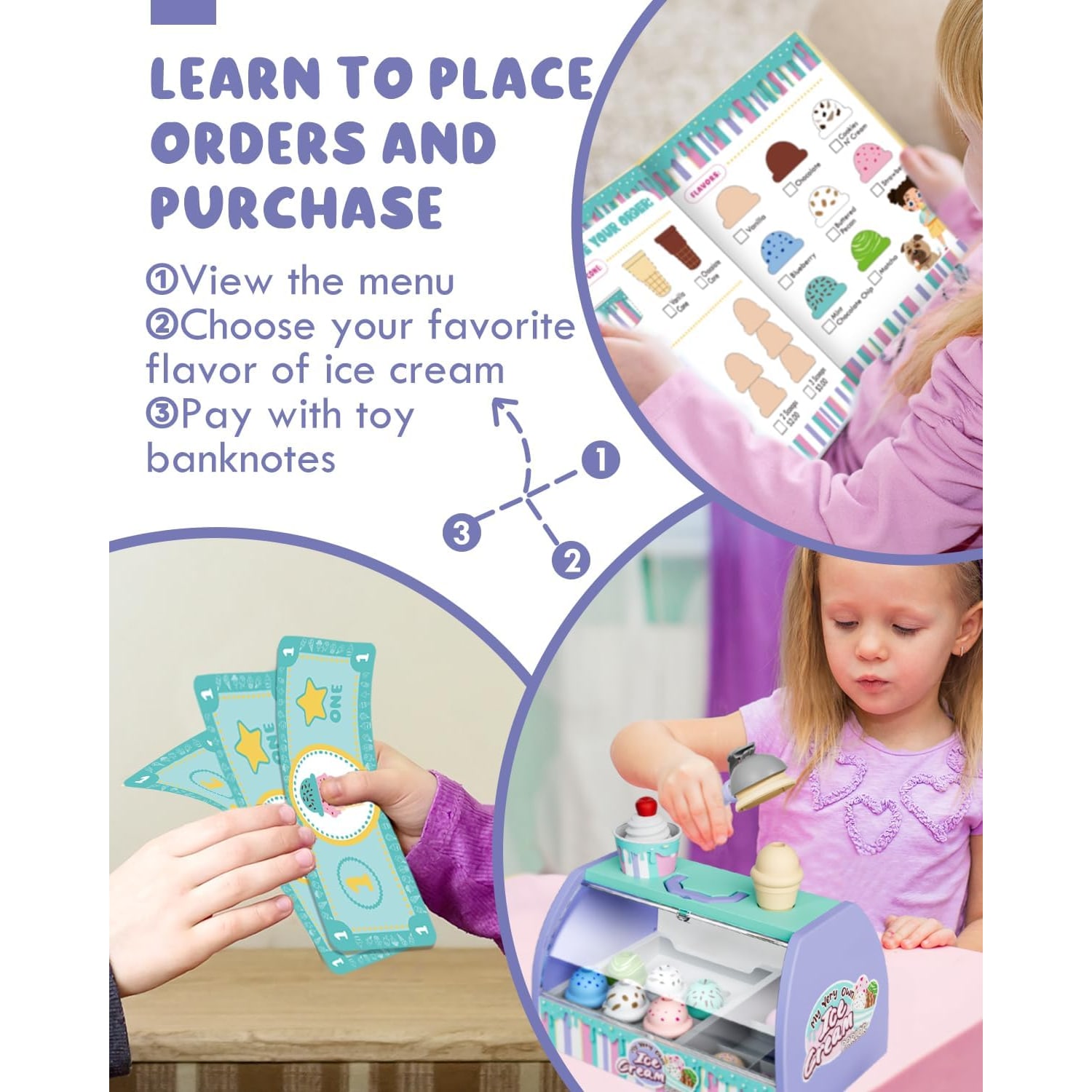
The set also includes serving accessories such as scoops, plates and cups. This is a bigger deal than it sounds. A cone on its own is an object. A cone on a plate, handed to someone who said please, is a scene. The accessories are what turn a stacking toy into kids play food you can run a shop with.
Who it suits
This set is for ages 3 and up. It has small pieces, so it is not for children under 3.
Around three, children start doing what people who study play call symbolic play. A wooden disc stops being a wooden disc and becomes strawberry. That is the sweet spot for a toy food set, because the child supplies the imagination and the toy just needs to be a decent prop.
It suits a few situations particularly well. If you already own a play kitchen, this works as play kitchen accessories and gives the kitchen something new to cook with. If you do not own a kitchen, it still works fine on a rug, a coffee table or the end of a bed. The set does not need a stage to perform on.
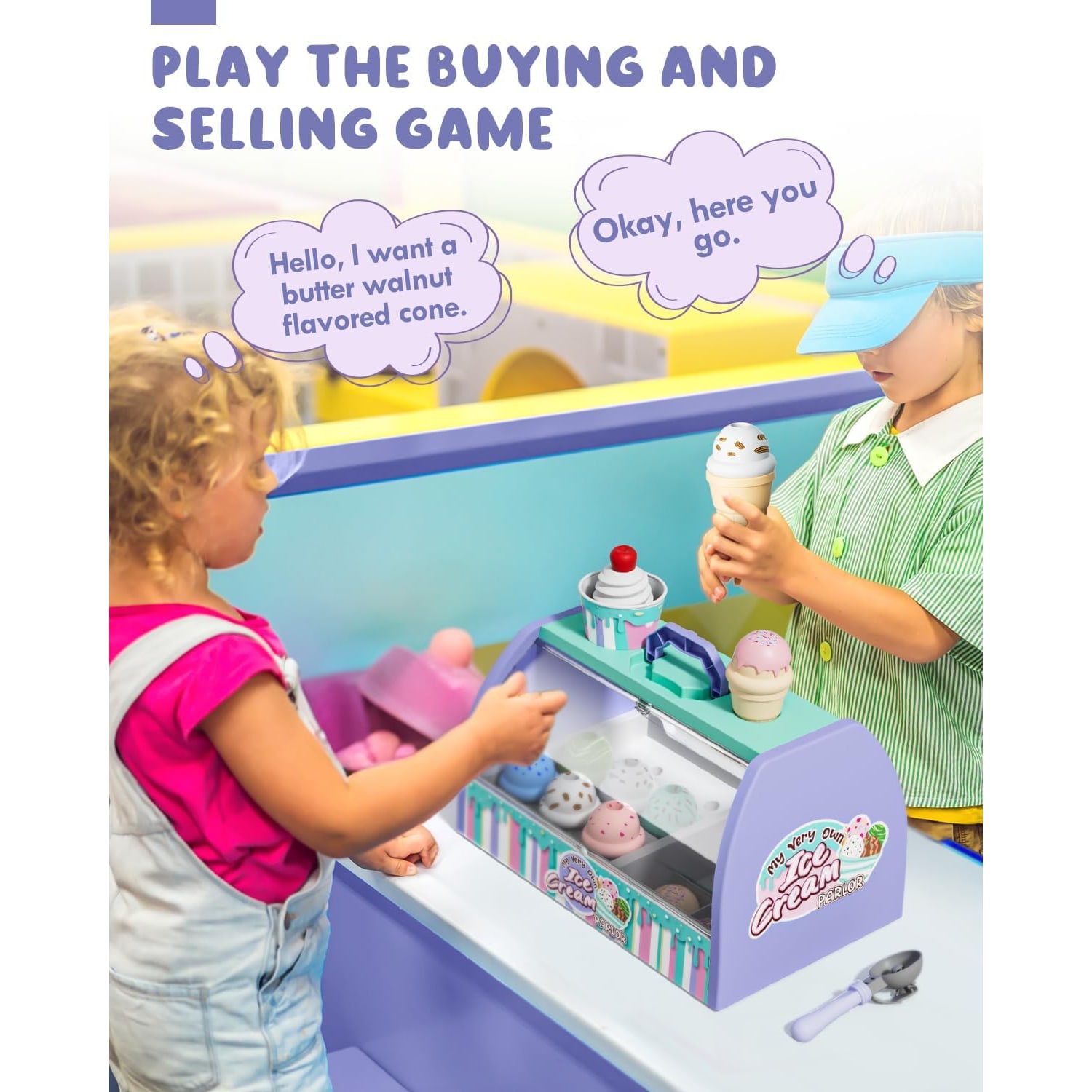
It also suits siblings or playdates. Two children with one shop will sort themselves into roles within about thirty seconds, usually with one of them firmly in charge. That is normal. Swapping who takes orders every few minutes keeps it civil.
What to look at when choosing play food
A few things actually matter when you are comparing imaginative play toys of this type.
Material. This set is wood. Wooden play food tends to feel more substantial than hollow plastic, and it handles being dropped on hard floors. It also does not creak or crack in the way thin plastic sometimes does. The trade-off is that wood does not like water, so it stays out of the bath.
Whether the pieces come apart. Fixed, one-piece food is fine but limited. Pieces that separate and recombine give a child more to do and more reasons to come back. This set is built around that mixing idea.
Scale. Play food that is too small is fiddly and gets lost under the couch. Too large and it will not fit on the plates a child already owns. This one is listed as child-size, with the whole set measuring 33 x 21 x 20 cm, which is roughly shoebox territory.
Extras. Scoops, plates and cups extend the play. Without them, a child builds and then has nowhere to go. With them, there is a sequence, build, plate, serve, clear, repeat.
Storage. Anything with multiple pieces needs a home. A shallow tub or a lidded basket works better than a deep toy bin, where the small serving pieces vanish to the bottom.
Getting more out of it
A toy like this gets more interesting when an adult joins in briefly and then steps back.
Try giving the shop a name. Ask for something ridiculous, like a cone with five scoops and no cherry. Pay with a leaf or a bottle cap. Pretend to be a very fussy customer who sends it back. Children find all of this extremely funny and it stretches the game well past the five minutes it would last on its own.
You can also tie it to other things you already have. A tea set turns it into a cafe. A small shopping basket makes it a supermarket. A notepad becomes an order book. None of this costs anything and it is how one standalone set becomes several different games.
A quiet tip, put the set away between sessions rather than leaving it out permanently. Toys that disappear for a week come back interesting.
Care and keeping it in good shape
Wooden toys are not demanding, but they do have one rule, keep them dry.
Wipe pieces with a soft cloth that is barely damp, then dry them straight away. Skip the dishwasher entirely, and do not leave the set soaking in a sink. Water gets into the grain, the wood swells, and any surface finish can lift.
Store it indoors somewhere dry. Garages, sheds and car boots go through big swings in temperature and damp, and wooden pieces do not love that.
Give the set a quick look over every so often. If a piece has chipped or gone splintery, take it out of circulation. One rough edge is not worth risking, and the rest of the set still works without it.
Avoid using the pieces with real food or play dough. Both stain, and both are a nuisance to get out of joints and grooves.
A few honest limits
It is worth saying what is not stated by the maker. The exact piece count is not specified, nor is the weight, nor a full breakdown of which colours are included beyond various colours. The brand is not listed either.
We would rather tell you that than guess. If a specific piece count matters for your purposes, send us a message before you order and we will check what we can confirm.
The short version
If you want a toy that keeps working after the novelty wears off, mix-and-match pretend food is a reliable bet. This wooden set gives a child flavours, toppings and shapes to combine however they like, plus scoops, plates and cups so they can actually serve what they make.
It measures 33 x 21 x 20 cm, it is made of wood, it needs no batteries and no assembly, and it is suitable for ages 3 and up. It works on its own or as an addition to a play kitchen you already have.
Keep it dry, store it in something with a lid, and expect it to be dragged out most afternoons for a good while.