
The complete guide
Choosing a Toy Microwave Play Set, A Practical Buyer's Guide
The gap in most play kitchens
Walk past almost any children's play kitchen and you will see the same layout. There is a hob with painted rings, a sink, maybe an oven door that opens onto an empty cavity, and a row of hooks for utensils. It looks complete. Then you watch a child use it and the pattern is always short. Chop something, stir it, announce dinner, wander off.
The missing piece is the appliance children actually see adults use most. Most households microwave something every single day, often more than once. Leftovers, a cup of tea, frozen peas, a hot water bottle. A child has watched that routine hundreds of times by the age of three, and they know the whole script. Open door, put food in, press buttons, wait, beep, take it out, careful it is hot.
A toy microwave gives them somewhere to put that script. That is why a set like this often gets more use than a far bigger wooden kitchen sitting right next to it.
What this set actually does
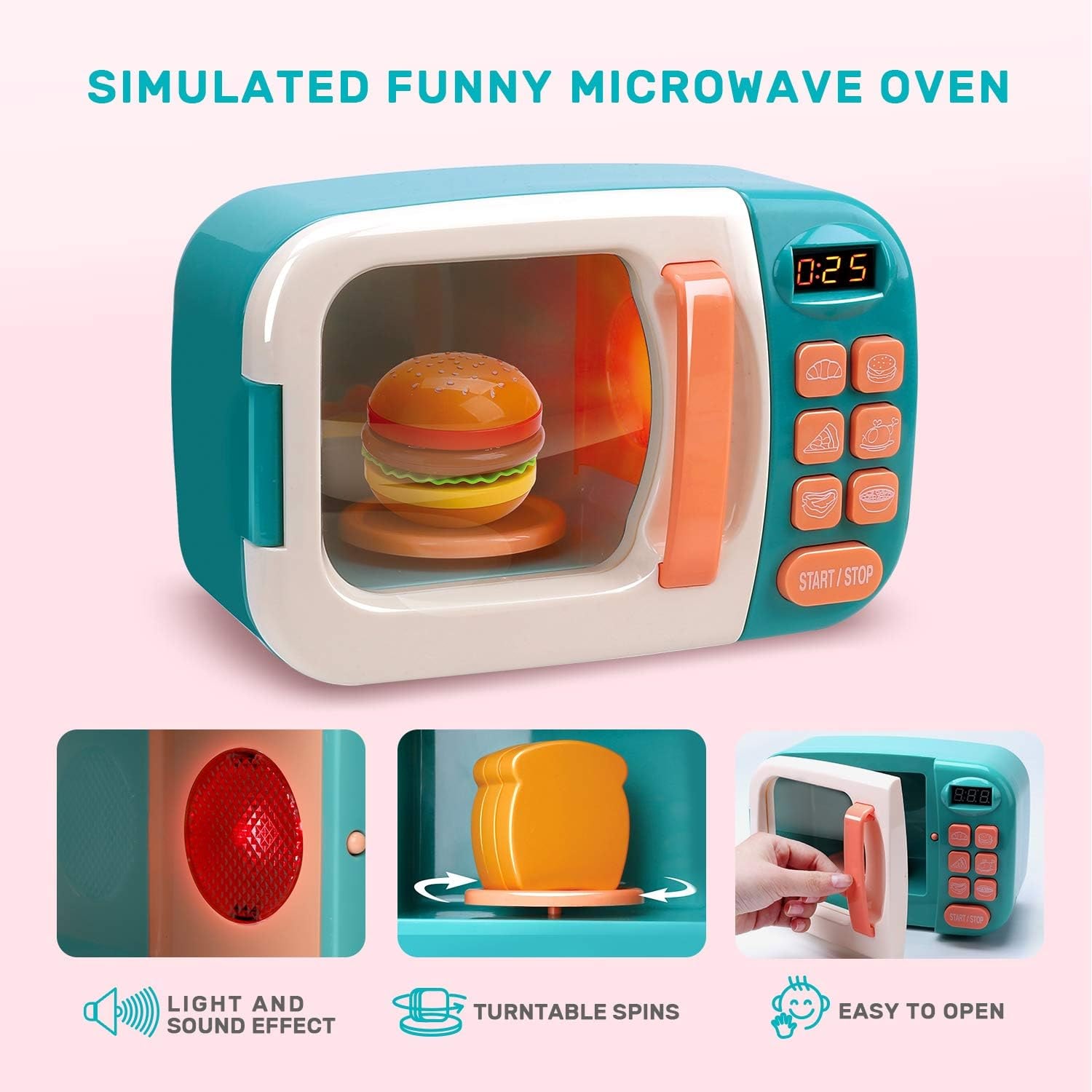
The microwave is electronic. It lights up, makes running sounds and the plate inside genuinely turns while it is going. The turning plate is the detail most children fixate on, because it is proof the machine is doing something. A button that only beeps gets old quickly. A button that starts a visible process does not.
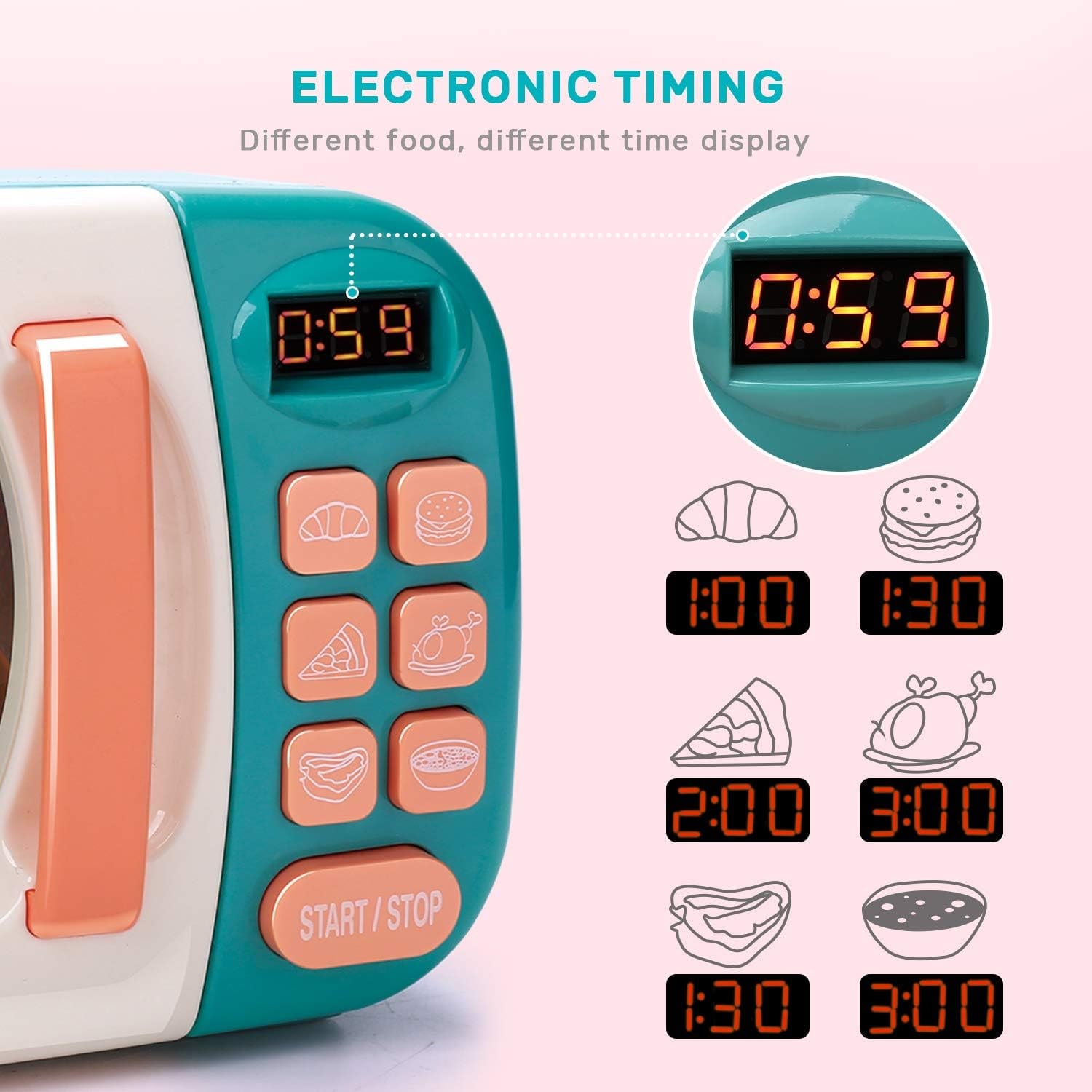
There is also a working timer with six different functions and six different time settings. That matters more than it sounds. A toy with one button offers one choice, and once a child has made that choice a few hundred times the toy is finished. Six functions crossed with six times gives a child something to decide every single round. Popcorn or defrost. Thirty seconds or three minutes. Those decisions are the whole point of the toy.
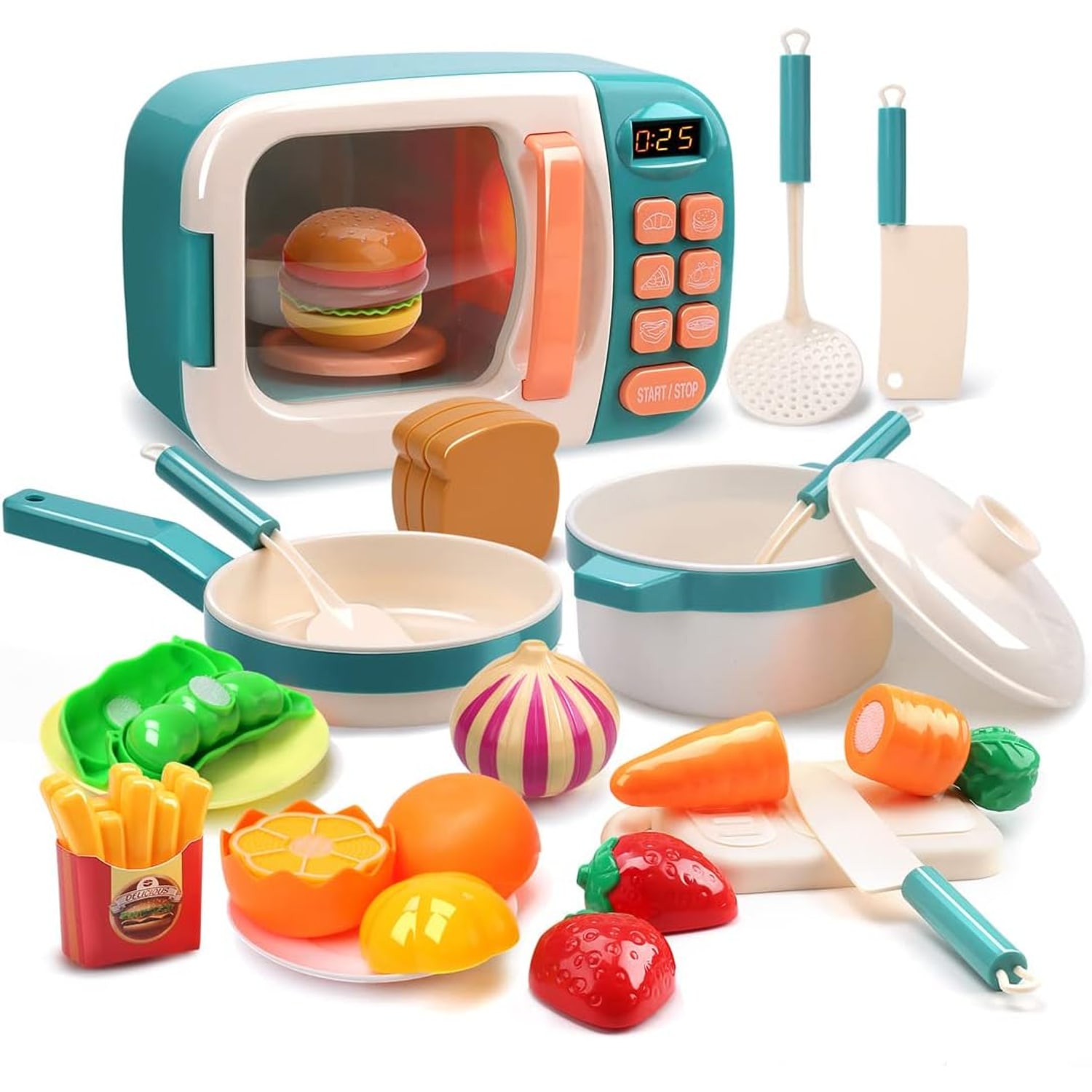
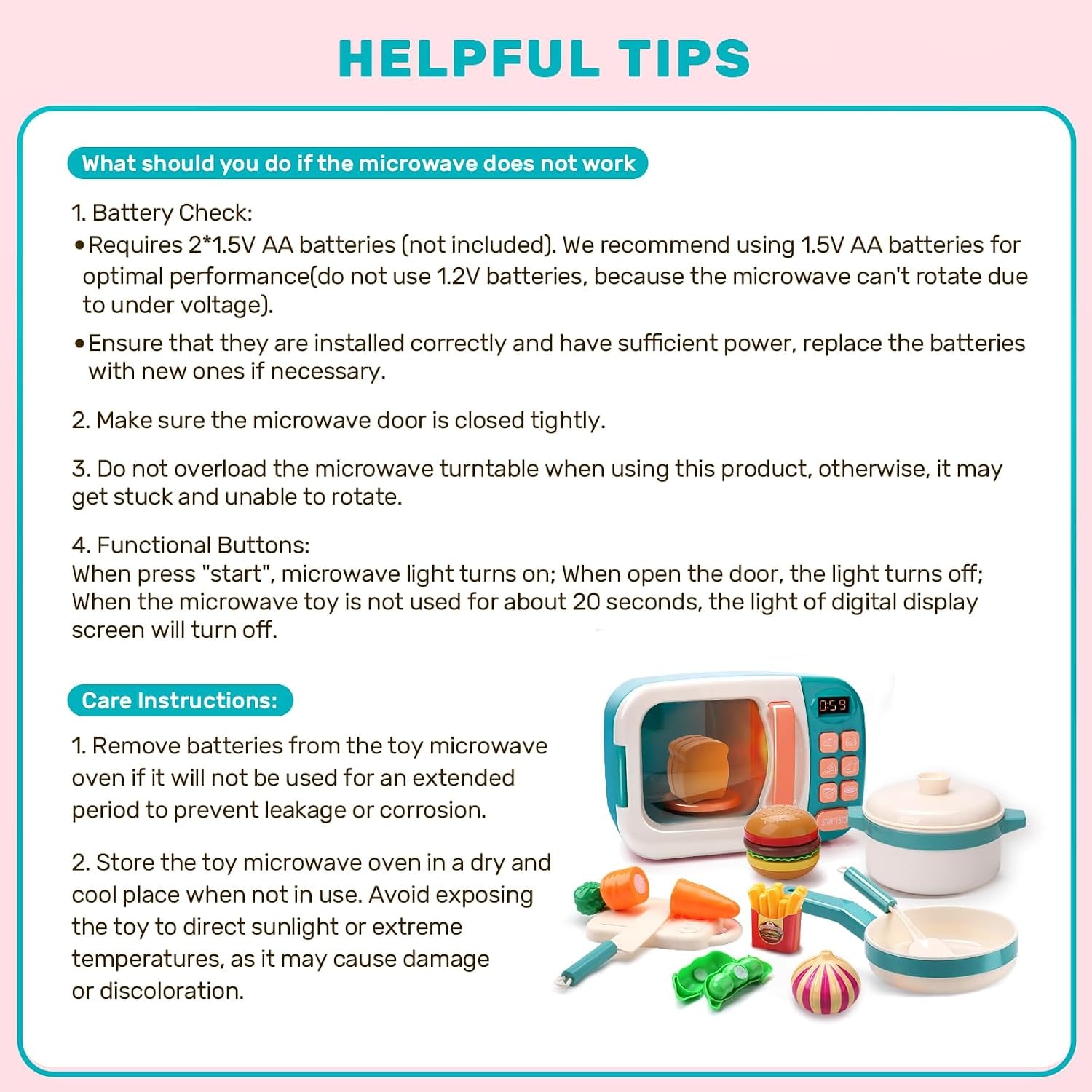
Around the microwave sits a complete prep kit. Eight cutting play food pieces that come apart with the two play knives and press back together. A chopping board to cut on. A pot and a pan. Three cooking utensils. That means a child can run the full sequence, prep on the board, cook in the pan, finish in the microwave, serve. No borrowing from other toy sets, no gaps where the story stops.
Who it suits
The set is for ages 3 and up. It contains small parts, so it is not suitable for children under 3, and that is worth taking seriously if there is a crawling sibling in the house. The food pieces are exactly the size and shape that end up in mouths.
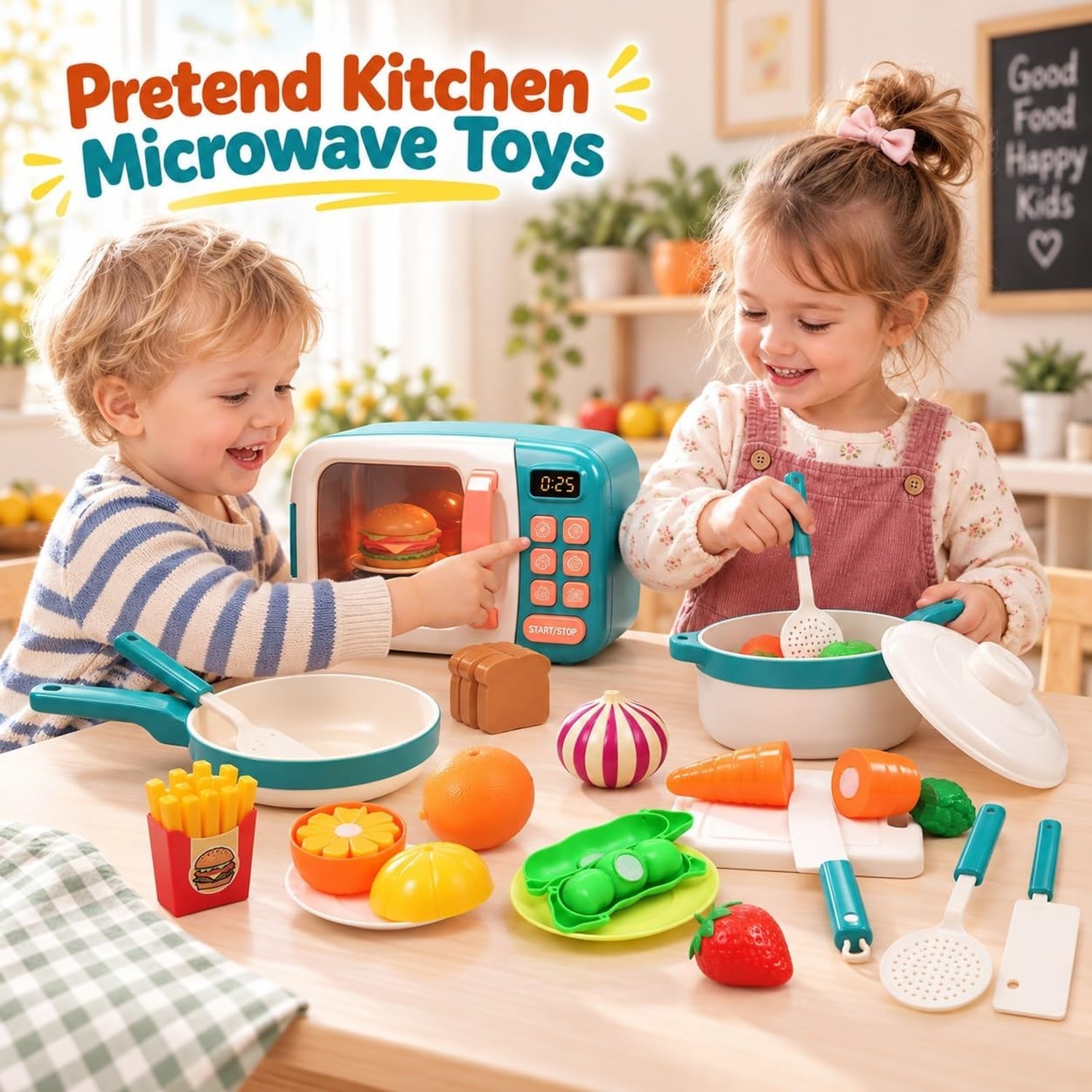
Three and four year olds tend to use it for straight imitation. They copy what they have seen in the family kitchen, sometimes word for word, including the warnings about hot plates. Five and six year olds start building longer stories around it. The microwave becomes part of a café, a restaurant, a hospital kitchen, a shop. That is the stage where having real cookware and cuttable food alongside the microwave pays off, because the story needs props to keep moving.
It also works well for mixed-age play. An older child can take the cooking role while a younger one handles the chopping, and the roles swap naturally without anyone needing to be taught how.
How to choose between options
If you are comparing a few sets, a handful of things separate the better ones from the rest.
First, look at whether the plate turns. Plenty of toy microwaves have lights and sounds but a fixed interior. The spin is the cheapest way to make the toy feel alive, and its absence is noticeable within a week.
Second, count the number of settings. A single-function microwave is a one-note toy. Six functions and six times, as in this set, gives enough variety that a child can invent rules about which setting is for which food.
Third, check whether food comes with it. A microwave on its own needs something to put inside, and if you have to buy play food separately the real price is higher than the sticker. Eight cutting pieces plus a pot, pan and three utensils means nothing else is needed on day one.
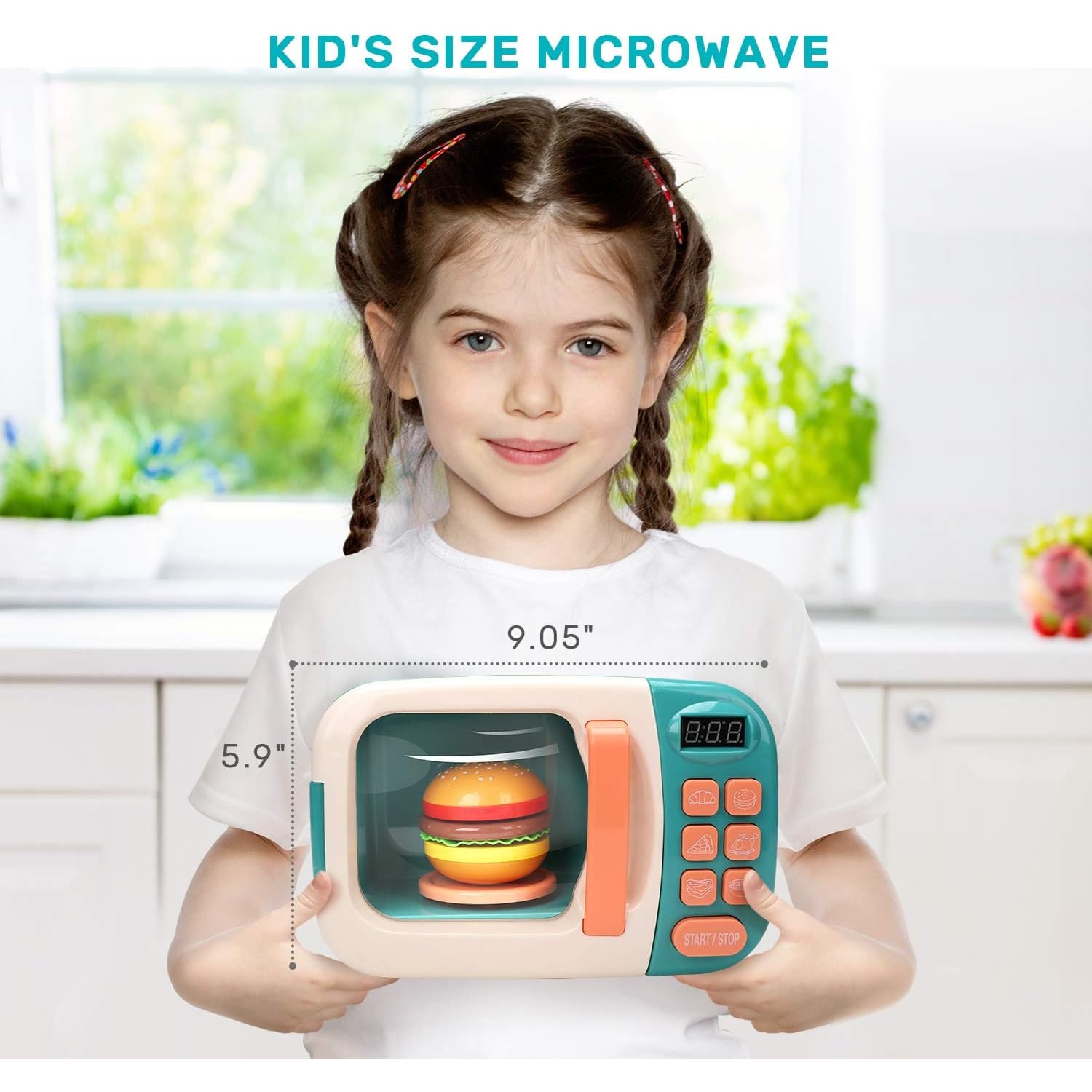
Fourth, think about size. This set is 23 x 15 x 10 cm and weighs 830 g. That is small enough to live on a shelf and light enough for a child to carry to wherever the play is happening. Bigger is not better for an appliance toy, because it stops being portable and starts being furniture.
Finally, consider how it fits what you already own. If you have a wooden kitchen, a compact microwave fills the obvious gap without needing to match the timber. The pastel colour scheme here reads as toy, not decor, which some families prefer and others do not. Have a look at where it will actually sit before you decide.
Getting the most out of it
The simplest way to extend the life of a kitchen toy is to keep the pieces together. A single shallow basket for the food, utensils and cookware, with the microwave beside it, means setup takes seconds and tidy-up takes about a minute. Sets that get scattered across three rooms stop being used, not because children lose interest but because starting becomes too much effort.
Adding a few non-toy props helps too. A tea towel, an empty cereal box, a pad and pencil for taking orders. Children layer real objects into pretend play constantly, and giving them permission to do so turns a kitchen set into an open-ended game rather than a closed one.
If the sounds become grating, taking the batteries out leaves a toy that still opens, closes and spins by hand. Plenty of families run it silent during quiet hours and switch it back on at the weekend.
Care and keeping it going
Wipe the microwave body and door with a barely damp cloth and dry it straight away. Keep water away from the battery compartment and the electronics. Nothing in this set should go near a dishwasher, a real microwave or an oven.
The food, utensils, knives, board, pot and pan can be hand washed in warm soapy water and left to air dry fully before going back in the basket. Damp plastic in a closed container is how things start to smell.
Check the battery compartment every few months. Leaking cells are the single most common reason an otherwise fine electronic toy ends up in the bin, and the fix is as simple as removing batteries if the toy is going into storage for a while.
Store it indoors and out of direct sun. Sustained sunlight fades pastel plastic and makes it brittle over time.
The short version
Most play kitchens are missing the one appliance children see used every day. This set fills that gap and brings the supporting cast with it, eight cuttable food pieces, two play knives, a chopping board, a pot, a pan and three utensils, so the whole cooking routine works from the first day.
The microwave lights up, makes sound, spins its plate and runs a timer with six functions and six settings, which is enough variety to stop it becoming a one-button toy. At 23 x 15 x 10 cm and 830 g it is compact, portable and easy to store.
It is for ages 3 and up and contains small parts, so it is not suitable for children under 3. If you already have a wooden kitchen, this slots in as the missing appliance. If you do not, it works perfectly well on its own with a low table standing in for a bench.