
The complete guide
How to Choose a Desk Globe That Earns Its Space
The problem with looking everything up on a screen
Ask where Paraguay is and most of us reach for a phone. Thirty seconds later we have an answer, a zoomed-in rectangle of green and a vague feeling that we still could not point to it on a blank map. Screens show you a piece of the world. They almost never show you the whole thing at once, and they never show it in correct proportion.
That is the gap a globe fills. A sphere is the only honest map of a sphere. Greenland is the right size. Africa is enormous. The distance from Perth to Johannesburg stops being an abstract number and becomes a span you can measure with two fingers. Having a globe within reach turns idle curiosity into something that actually sticks.
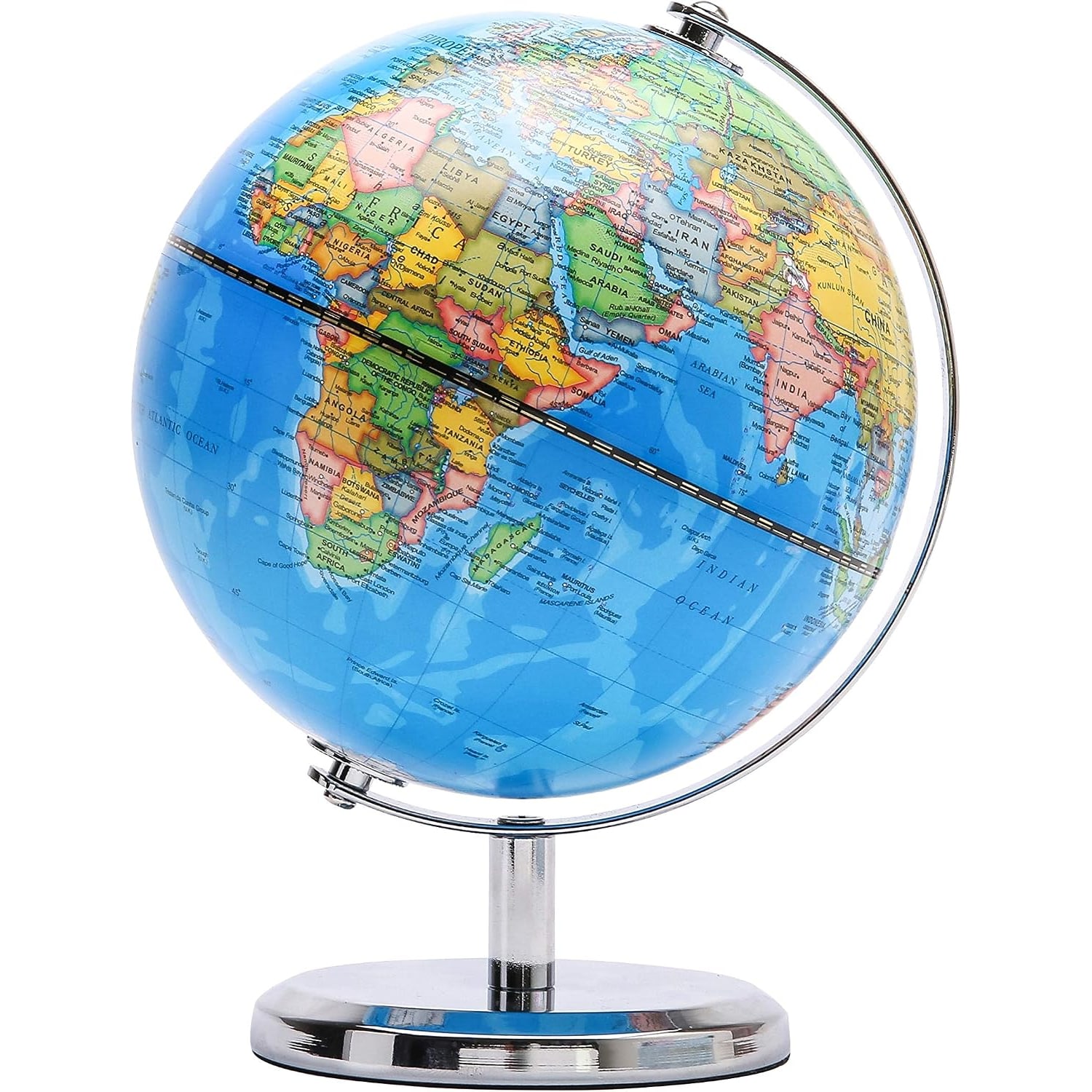
A world globe 20cm across is the version of that idea built for daily life rather than display. It sits on a desk, gets spun during phone calls, and answers questions without anyone opening a browser tab.
What political actually means on a globe
Globes mostly come in two flavours. A physical map shades terrain, showing mountain ranges, deserts, plains and ocean depth in greens, browns and blues. A political map ignores all of that and colours each country separately, marking political boundaries, capital cities and major cities.
Most people want political. It is the map that answers the questions that come up in real life. Which countries border Switzerland. Whether Lagos or Abuja is the capital of Nigeria. How many countries you pass over flying from London to Delhi. A physical globe is lovely for geology and geography lessons about landforms, but the political globe is the everyday reference.
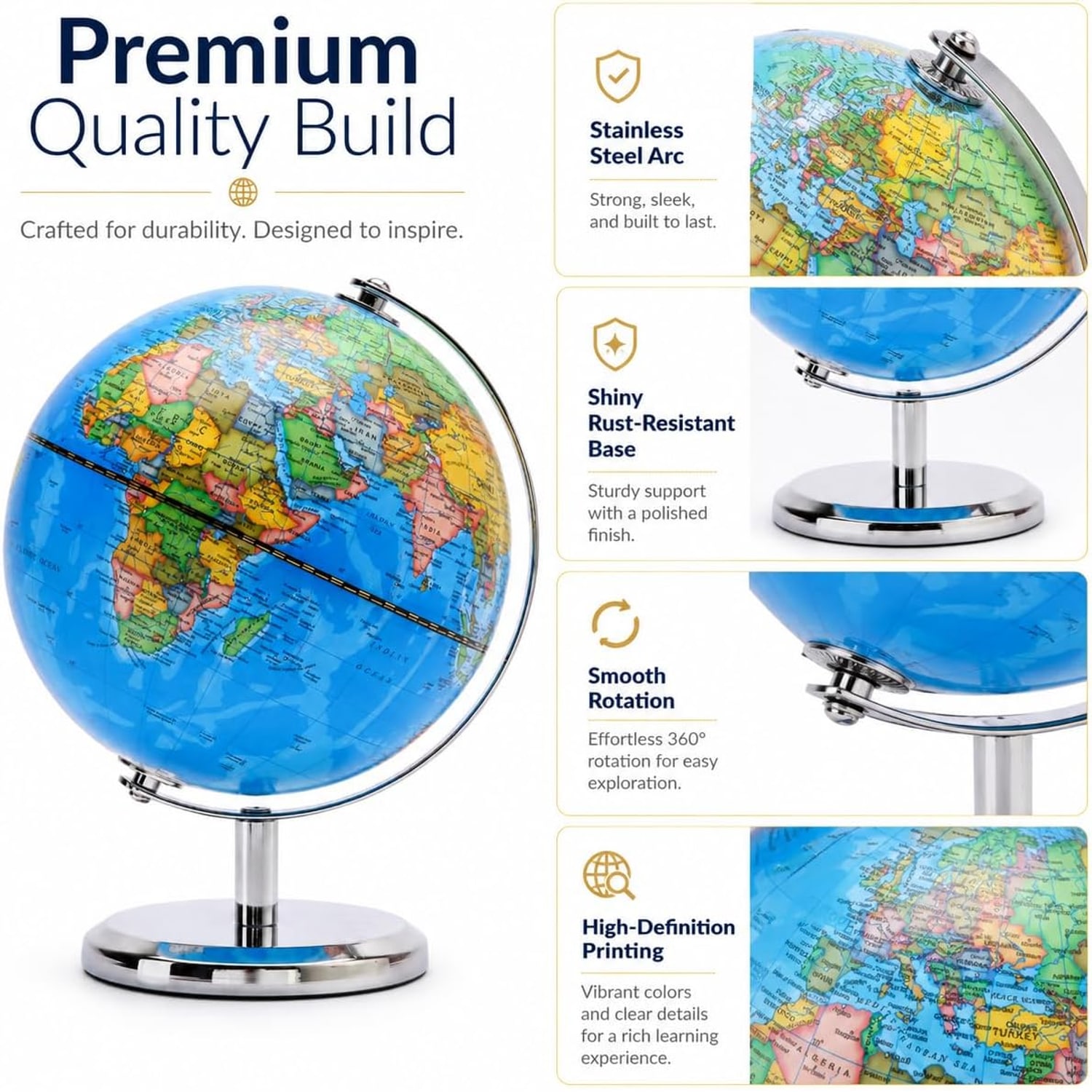
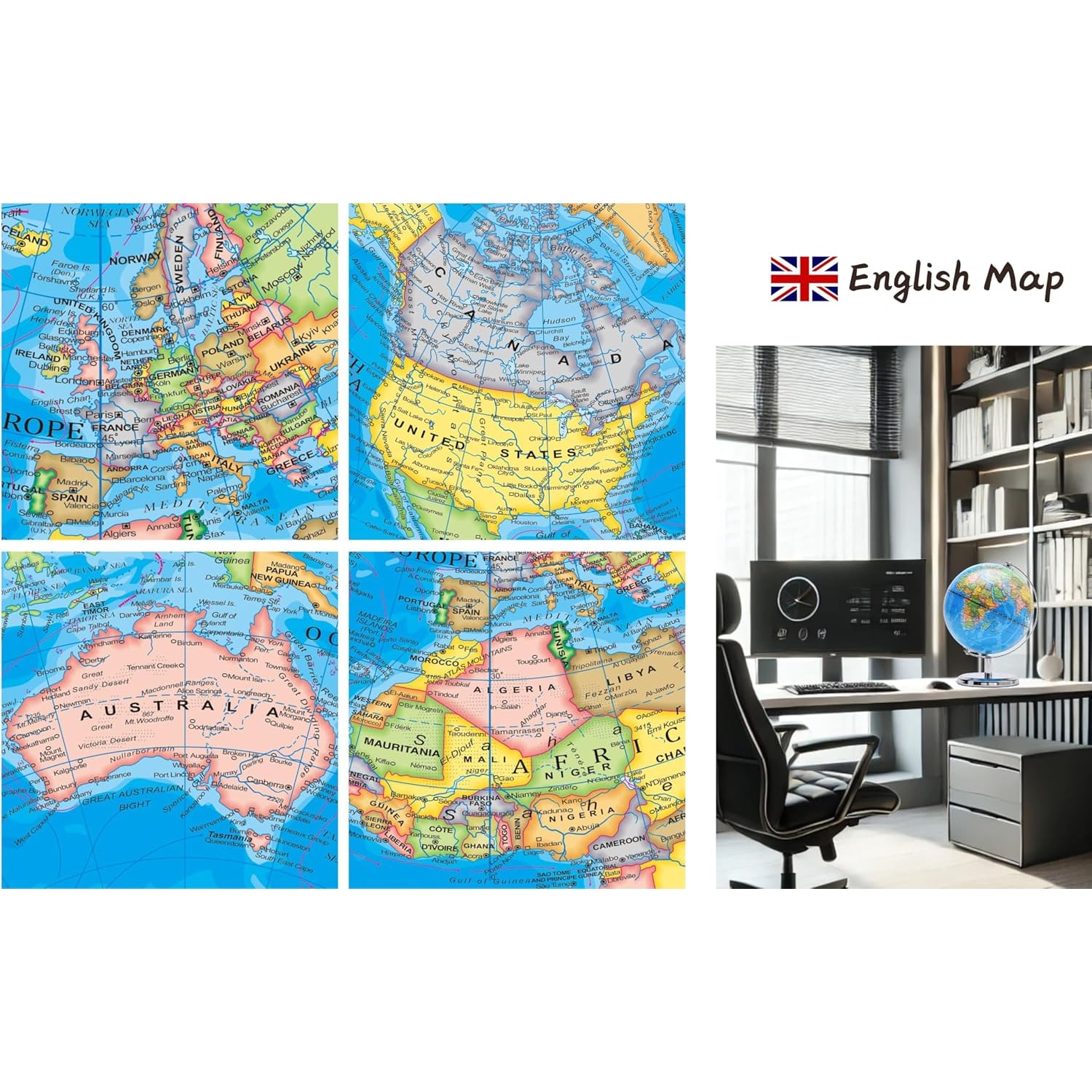
This one prints its political map fine and clear, which sounds like a small thing until you have handled a cheap globe where half the Balkans are an unreadable smudge. Legibility at 20 centimetres takes decent printing, because that is a lot of information crowded onto a modest surface.
Why 20 centimetres is the sensible size
Globe sizing is a trade-off between readability and footprint. The small ones, around 10 to 15 centimetres, are charming and nearly useless for reading European or Caribbean labels. The big display globes, 30 centimetres and up, are gorgeous and need a dedicated table or stand.
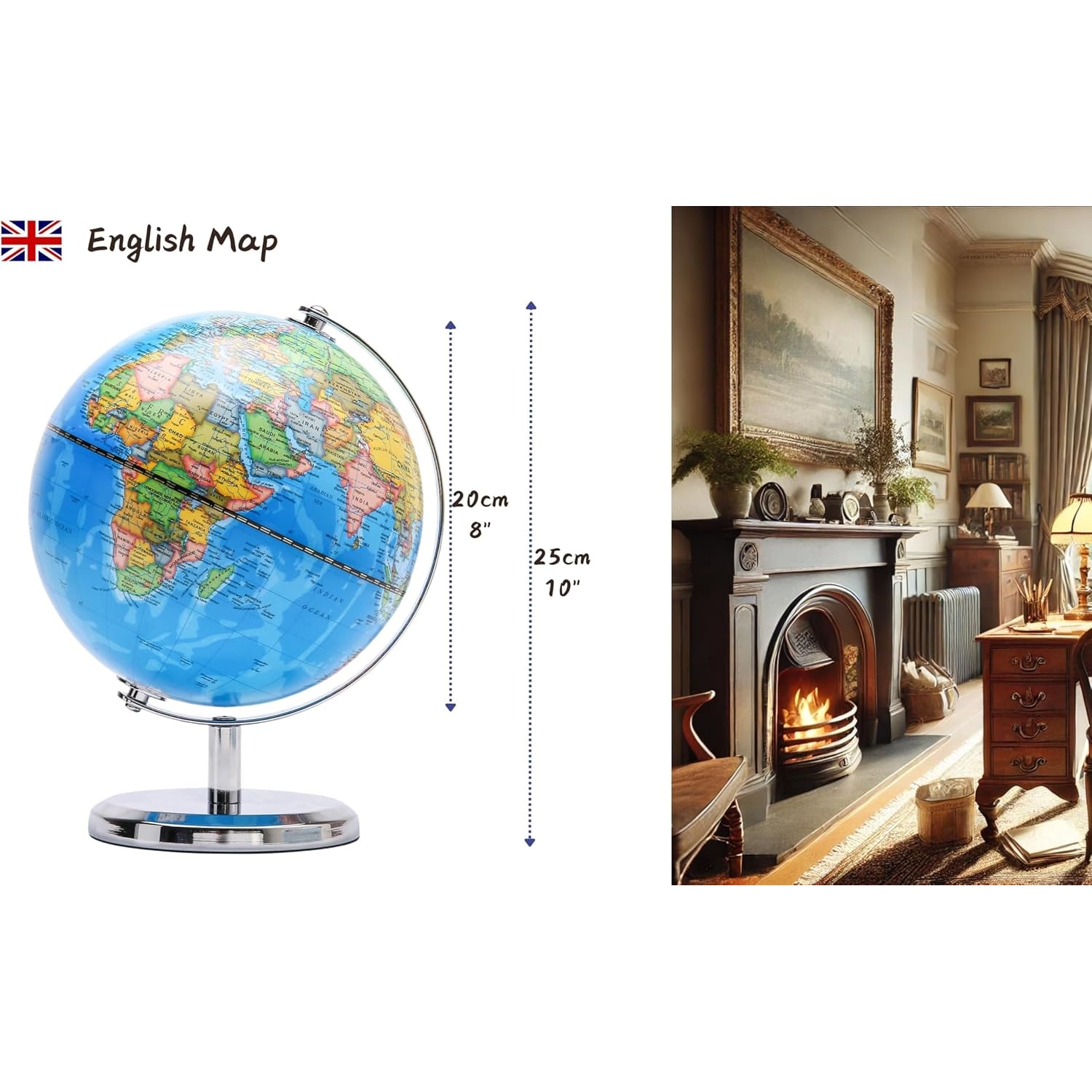
Twenty centimetres is the compromise most households land on. The sphere surface is large enough that country names in crowded regions still print at a readable size. The whole assembly still fits beside a monitor, on a shelf between books, or on a hallway console without blocking anything.
If you are after the best small world globe for a study desk, this is roughly the size band to shop in. Just remember to measure the height you have available rather than the diameter alone. The arc and base add to the sphere, so a shelf gap of exactly 20 centimetres will not do.
The base is not a detail
A lot of cheap globes fail at the base. Hollow plastic stands are light, so the whole thing skates across the desk when someone spins the sphere, and the arc flexes until the globe will not hold its tilt.
Here the arc and base are stainless steel with a polished finish, and total weight is 1.15 kilograms. That weight is doing a job. It plants the globe on the desk, so a firm spin turns the sphere rather than shoving the base. Steel also keeps its shape, which means the sphere stays properly seated in the arc over years of use rather than gradually slumping.
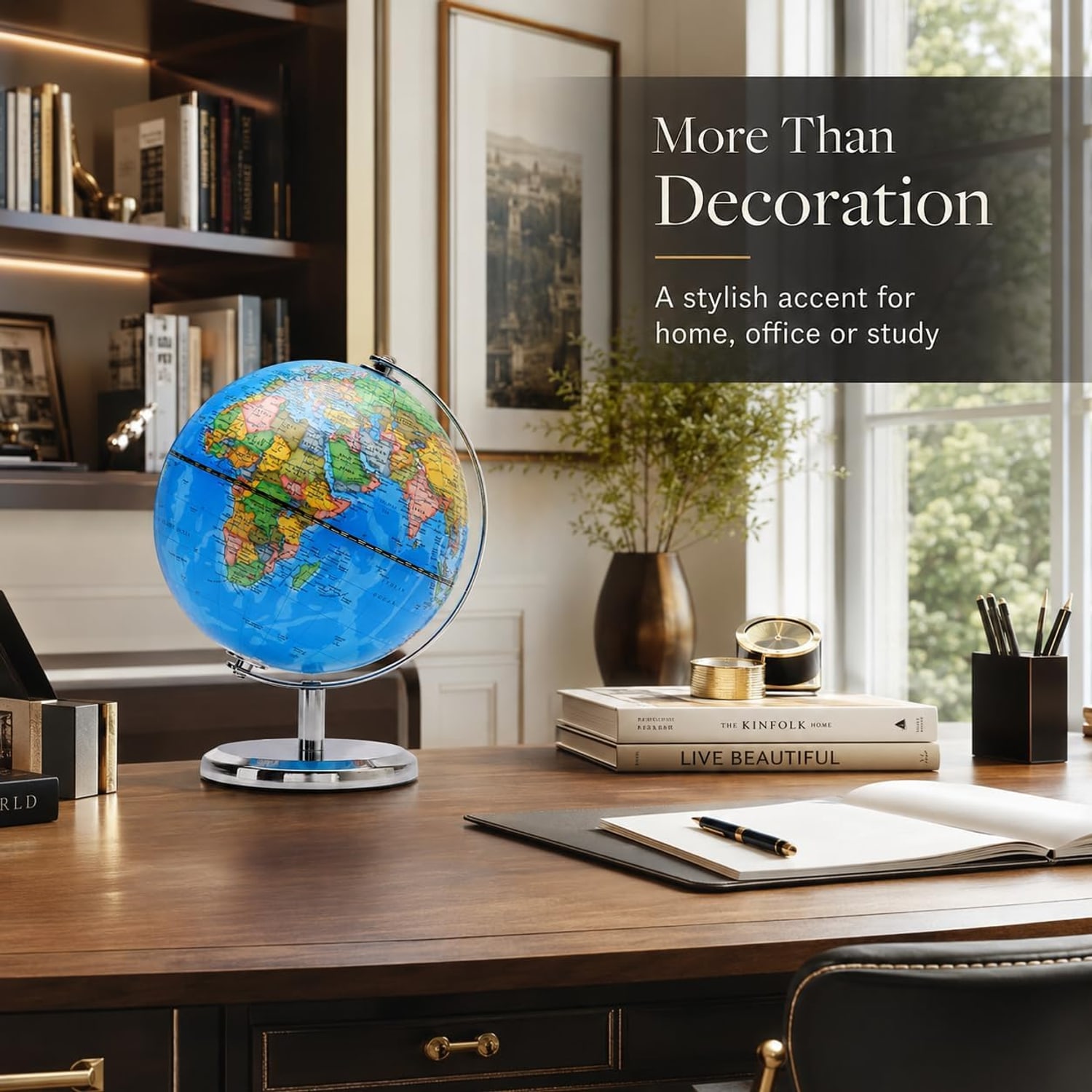
The polished finish has a practical side too. It shows fingerprints a little, but a dry cloth clears them in seconds, and it reads as clean and modern next to a laptop, a steel lamp or a glass-topped desk.
Who gets the most out of one
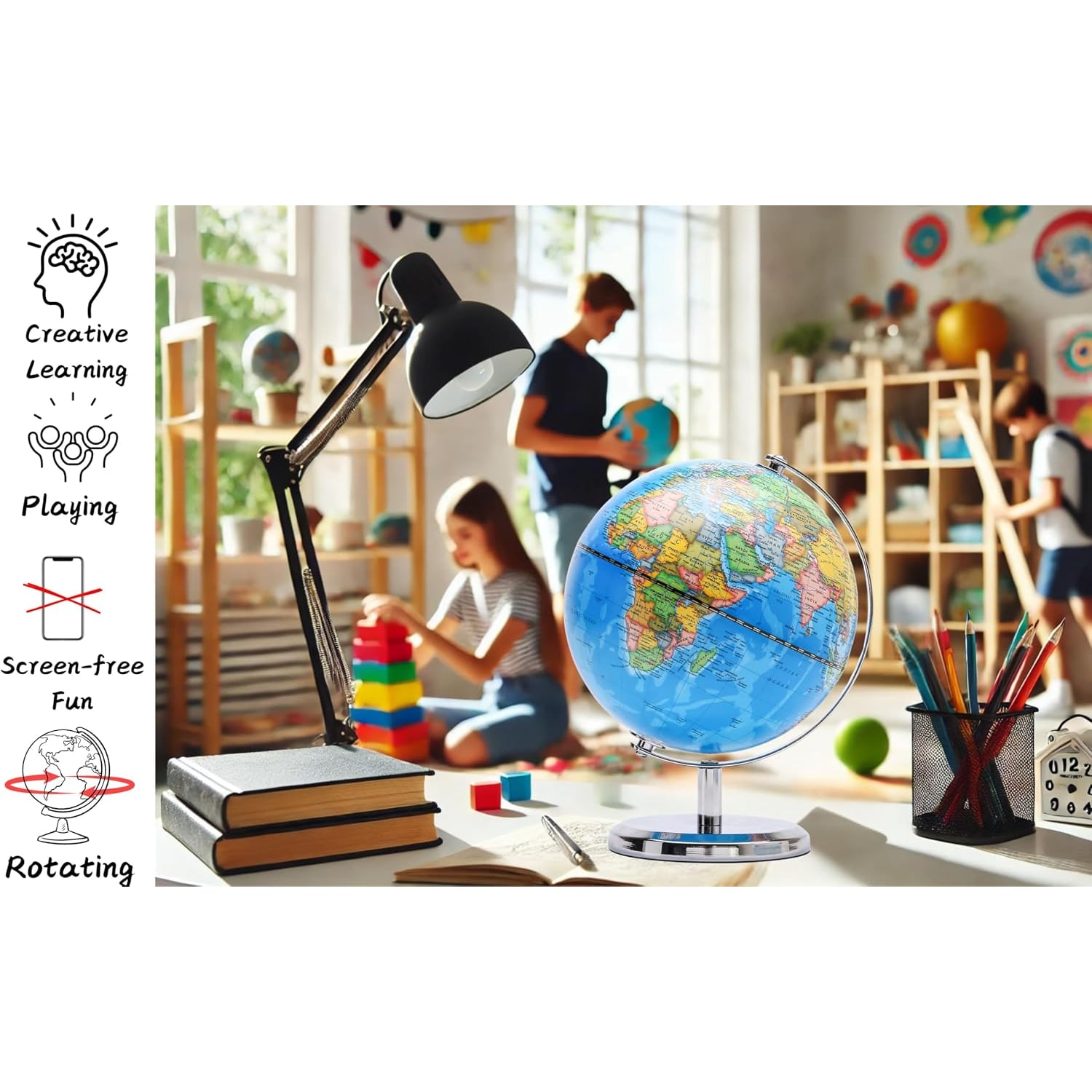
Students are the obvious group. A globe on a study desk is the best geography globe for kids in the simple sense that it is there, visible, during homework. Children who would never open an atlas will spin a globe out of habit and absorb a surprising amount by accident.
Adults use them differently. People who read international news like having somewhere to point when a place name comes up. Travellers plan with them, because a sphere tells you honestly how far it is from one place to another and which way a flight path actually curves. Plenty of people buy one as the best decorative globe for a study and then find it has become the thing they fiddle with while thinking.
Teachers and tutors use a 20 centimetre globe as a table reference, small enough to pass around a group, big enough that three or four people can read it at once.
How to choose between globes
A few questions sort most of it.
First, political or physical. If the globe is for homework, news and travel, choose political. If it is for a geography specialist or someone fascinated by terrain, look at physical instead.
Second, size against space. Measure the gap. Add room above the sphere for the arc, and leave a little clearance so the globe is not rubbing on a shelf above it when it spins.
Third, stand material. Steel and timber both outperform hollow plastic for stability. Steel suits modern rooms, timber suits traditional ones.
Fourth, print quality. Fine, clear type is what separates a reference tool from an ornament. If you cannot read the names, the globe is decoration.
Fifth, lighting. Illuminated globes glow from inside and often switch between political and physical maps as the lamp comes on. They need a power cord nearby. This globe is a standard non-illuminated model, so there is no cable to run and nothing to plug in.
Keeping it looking good
Globe care is genuinely easy. Dust the sphere with a dry soft cloth, or a barely damp one if something has marked it, then dry it immediately. Printed map surfaces do not enjoy standing moisture.
Skip household sprays, solvents and anything abrasive. Those lift print, and once a country has faded off the surface there is no fixing it. The same goes for sticky tape and markers.
Sunlight is the slow enemy. A globe parked on a bright windowsill will fade across its sunward side over a year or two, which leaves you with one bleached hemisphere. A desk, a shelf away from direct glare, or a corner of a room keeps the colours even.
For the steel arc and base, a dry cloth is all it takes. Polished stainless shows marks and loses them just as quickly.
The short version
A 20 centimetre political globe is one of those objects that quietly earns its keep. The map shows countries, political boundaries, capital cities and major cities in clear print. The sphere is plastic, the arc and base are polished stainless steel, and the whole thing weighs 1.15 kilograms, which is enough to stay put under a decent spin.
It fits a desk, a shelf or a classroom table. It answers questions faster than a search, and it shows the world in proportion rather than in a cropped rectangle. Buy it for a student and it helps with homework. Buy it for a study and it becomes the thing guests reach for. Either way, it gets used, and that is more than most desk objects manage.